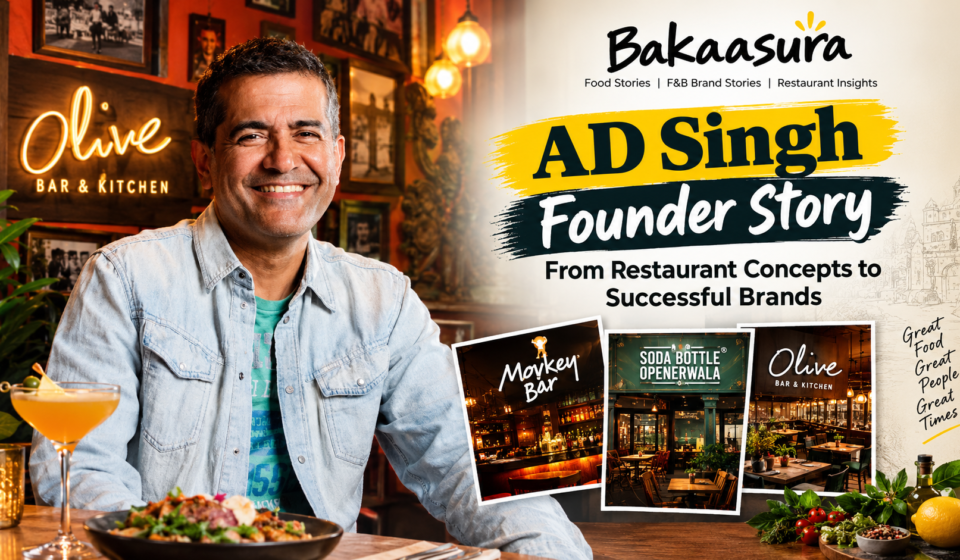

AD Singh is one of the entrepreneurs who helped reshape India’s modern restaurant industry. Long before experiential dining, gastropubs and concept-driven restaurants became common phrases in the Indian food business, Singh was experimenting with ways to make eating out more social, creative and memorable.
His journey did not begin with formal training in hospitality. Singh studied electrical engineering at Lafayette College in Pennsylvania and later worked with companies including TCS and Cadbury. He also spent time working with NGOs and writing a food column before finding his entrepreneurial calling in food and hospitality.
His first major food venture was Just Desserts, a jazz café launched in Mumbai in 1990 with an investment of about ₹50,000. The concept combined desserts, coffee, jazz and a relaxed café atmosphere at a time when standalone dining was still relatively uncommon.
The defining moment came in 2000, when Singh launched Olive Bar & Kitchen in Bandra, Mumbai. Its Mediterranean-inspired food, whitewashed interiors, relaxed atmosphere and emphasis on design and conversation helped establish a different model of standalone dining.
Over the following decades, Singh developed a portfolio that included Olive Bar & Kitchen, Olive Beach, Monkey Bar, Guppy, SodaBottleOpenerWala, The Fatty Bao, Toast & Tonic, The Grammar Room, The Hoppery, Olly and other concepts.
His story is therefore not simply about opening restaurants. It is about turning ideas, design, cuisine and customer experience into scalable restaurant brands.
Early Life and Education
AD Singh was born in Delhi in 1960 and grew up in Mumbai. He attended Cathedral and John Connon School before studying at Jai Hind College and St. Xavier’s College, followed by an electrical engineering degree from Lafayette College in Pennsylvania.
Engineering was not ultimately the career he wanted.
After returning to India, Singh worked with corporate organisations including TCS and Cadbury. However, the conventional corporate path did not provide the creative freedom he was looking for.
He eventually left that world and explored work with NGOs and food writing.
That period proved important because it gave him exposure to people, culture and ideas outside traditional corporate structures.
From Engineering to Entrepreneurship
Singh has described his entry into entrepreneurship as something of an accident.
In 1988, he organised a boat party for his sister’s wedding. The event was successful enough to convince him that there could be a business opportunity in organising unusual social experiences.
He subsequently started Party Lines, a boat-party planning business.
The venture gave him his first practical experience in hospitality, entertainment, customers and event management.
It also introduced an idea that would remain central throughout his career: people were not simply buying food or drinks; they were buying an experience.
Just Desserts: The First Restaurant Experiment
In 1990, Singh launched Just Desserts, a small jazz café in Mumbai.
The concept was remarkably simple. It focused on coffee and desserts, with jazz music providing the atmosphere.
Singh reportedly invested around ₹50,000 in the venture. He later said that the business did not make significant money, but the experience taught him invaluable lessons about customers, operations and creating a distinctive environment.
The café became known as an important standalone dining concept of its period.
The significance of Just Desserts was not necessarily its financial scale. It was the learning platform that gave Singh confidence to continue experimenting.
Read this – India’s top restaurant founders and restaurateurs
Learning Through Failure and Experimentation
The early years were filled with experiments.
Singh was involved in several concepts, including Suzie Wong, The Bowling Company and other ventures before Olive became his defining brand.
Some of these businesses did not become large commercial successes.
But Singh has repeatedly described those experiences as valuable because they helped him develop credibility, understand customers and learn how to build restaurants around ideas.
This willingness to experiment eventually became one of the defining features of his career.
2000: The Birth of Olive Bar & Kitchen
The biggest turning point arrived in 2000.
Singh opened Olive Bar & Kitchen in Bandra, Mumbai.
The restaurant was visually distinctive, with whitewashed walls, a relaxed Mediterranean-inspired aesthetic and an atmosphere built around food, cocktails, music and conversation.
It was also strategically located in Bandra at a time when the neighbourhood was developing into one of Mumbai’s major lifestyle and dining destinations.
The Olive Group describes the original restaurant as a rustic hideaway where food, drink, conversation and social interaction came together.
Changing the Standalone Restaurant Model
At the beginning of the 2000s, many Indian consumers still associated premium dining heavily with five-star hotels.
Olive offered another possibility.
It brought elements of high-quality dining, sophisticated interiors and hospitality into an independent restaurant setting.
The National Restaurant Association of India credits Singh with helping develop the standalone restaurant concept in India and notes that Olive was recognised among Mumbai’s leading restaurants soon after opening.
The Indian Express, reflecting on Olive’s 25th anniversary in 2026, described Singh as one of the people who helped drive India’s shift toward experience-led standalone dining.
Olive Becomes More Than a Restaurant
Olive gradually developed into a lifestyle brand.
Its appeal was not limited to the menu.
The restaurant became associated with art events, music, brunches, celebrity gatherings and social occasions.
That combination helped make Olive a destination rather than simply another place to eat.
The Economic Times noted that Olive became a prominent Mumbai social venue, attracting celebrities, business leaders and other public figures.
This was important to Singh’s wider business philosophy.
A restaurant could become a platform for culture, conversation and community.
Expansion to Delhi and Other Cities
Following the success of Olive in Mumbai, Singh expanded the brand.
Olive opened in Delhi in 2003, and subsequent locations and concepts were developed in Bengaluru, Goa, Hyderabad and other markets.
By 2017, Mint reported that Olive Bar & Kitchen Pvt. Ltd. was operating 32 outlets across Delhi, Mumbai, Bengaluru, Hyderabad, Pune and Kolkata.
The expansion demonstrated that the business was no longer dependent on one flagship restaurant.
It was becoming a platform for multiple concepts.
Read this – Who Is Amit Burman? Founder Story, Career and Business Journey
Olive Beach and the Next Phase
Singh continued experimenting with different formats under the Olive umbrella.
Olive Beach became an important Bengaluru concept, introducing a Mediterranean-inspired dining experience to the city.
The brand demonstrated that Singh was not simply replicating Olive Bar & Kitchen.
Instead, each restaurant could have a distinct personality while still benefiting from the wider group’s experience.
This became the foundation for his multi-brand strategy.
Monkey Bar: Bringing the Gastropub to India
One of Singh’s most recognisable concepts was Monkey Bar.
The brand was developed as a gastropub combining food, cocktails, music and a lively social environment.
The Olive Group and National Restaurant Association of India have described Monkey Bar as India’s first gastropub.
The first Monkey Bar opened in Bengaluru in 2012.
It was designed for a younger audience looking for a more casual alternative to formal restaurants and traditional bars.
The concept was later expanded to cities including Mumbai, Delhi and Kolkata.
Why Monkey Bar Worked as a Brand
Monkey Bar demonstrated Singh’s ability to identify changes in consumer behaviour.
Younger urban customers increasingly wanted restaurants that could combine:
- Food
- Cocktails
- Music
- Socialising
- Casual interiors
- Entertainment
Instead of treating these as separate categories, Monkey Bar brought them together.
That was consistent with Singh’s larger philosophy of creating experiences rather than merely selling meals.
SodaBottleOpenerWala: Reviving the Irani Café
Another important concept was SodaBottleOpenerWala.
Launched in 2013, the brand drew inspiration from Mumbai’s Irani café culture and Parsi food traditions.
The concept combined nostalgia with contemporary restaurant design.
The first outlet was launched at Cyber Hub in Gurgaon, and the brand subsequently expanded to other cities.
SodaBottleOpenerWala demonstrated another aspect of Singh’s strategy.
Instead of importing an international restaurant concept, he could take a culturally specific Indian story and turn it into a contemporary brand.
The restaurant experience incorporated food, interiors, storytelling and nostalgia.
Guppy and Japanese Dining
Singh also entered Japanese cuisine with Guppy.
The restaurant was positioned as a contemporary Japanese concept with a playful approach to food and design.
Guppy opened in New Delhi in 2013 and later expanded to Mumbai.
The brand subsequently received recognition in the Times Food Awards, including Best Japanese in Delhi in 2014, 2015 and 2017, according to its official website.
This was another example of Singh’s approach to international cuisines.
The goal was not simply to reproduce a foreign restaurant.
The concept had to be adapted to Indian customers while retaining enough authenticity to remain recognisably Japanese.
The Fatty Bao and Asian Dining
The Olive Group also became associated with The Fatty Bao, an Asian gastro-bar concept.
The brand focused on Asian-style food in a contemporary setting, again combining food with design and nightlife.
In a 2019 interview, Singh described The Fatty Bao as one of the group’s growing brands, alongside SodaBottleOpenerWala, Monkey Bar and Guppy.
The expansion of these concepts showed that the Olive Group was becoming more like a creative restaurant studio.
Each brand could explore a different cuisine, audience or experience.
From One Brand to a Restaurant Portfolio
The transformation of Olive from one restaurant into a multi-brand group was one of Singh’s most significant business achievements.
The company’s portfolio over the years has included:
- Olive Bar & Kitchen
- Olive Beach
- Olive Bistro & Bar
- Olive Café & Bar
- Monkey Bar
- SodaBottleOpenerWala
- Guppy
- The Fatty Bao
- The Grammar Room
- The Hoppery
- Olly
- Toast & Tonic
- Ek Bar
- The Love Hotel
- Other experimental concepts
The exact portfolio has changed over time as brands have opened, closed, evolved or been repositioned. The Olive Group’s current website continues to list multiple concepts, including newer ventures such as Call Me Sofia.
Read this – Best Restaurants in Koramangala for Every Occasion
The Philosophy Behind AD Singh’s Restaurant Brands
Singh’s approach can be understood through several recurring principles.
Strong Concepts Come First
For Singh, the concept is the starting point.
Before developing a restaurant, the team needs to understand what makes it different.
The cuisine, interiors, music, service and customer profile must support that idea.
Design Is Part of the Product
Singh has consistently treated design as an important part of restaurant development.
Olive’s whitewashed Mediterranean look became inseparable from the brand.
Similarly, SodaBottleOpenerWala used nostalgia and visual storytelling to create a different identity.
The restaurant therefore becomes a complete experience rather than a room containing tables.
Keep the Experience Fresh
Singh has emphasised innovation and the need to respond to changing consumer expectations.
In a 2015 interview, he discussed the importance of having a strong concept, executing it effectively and keeping the experience fresh.
This philosophy helps explain why the Olive Group repeatedly introduced new brands rather than depending exclusively on its flagship restaurant.
The Shift Toward Casual Dining
One of the biggest changes in Singh’s business strategy was diversification into more casual and accessible formats.
As younger consumers became less interested in formal dining, Singh recognised the need for brands that were more relaxed.
He explained that customers were increasingly looking for casual cafés and easier, more informal experiences, which encouraged the group to diversify beyond the original Olive format.
This led to brands such as Monkey Bar and SodaBottleOpenerWala.
The move allowed the company to reach different customer groups and price segments.
The Challenges Behind the Success
AD Singh’s career has also included significant business setbacks.
His early ventures did not all generate strong financial returns.
The 2008 global financial crisis also affected the restaurant business. Singh had opened expensive concepts in Delhi shortly before the crisis, and he later recalled that champagne sales fell and Sunday brunches became thinner.
These pressures demonstrated the vulnerability of restaurants to broader economic conditions.
Read this – Chinese Restaurants in Indiranagar, Bengaluru
Olive Delhi Shutdown
Another major challenge came when Olive’s Delhi location was shut following a Supreme Court-related action concerning illegal construction.
Singh has said that although he was a tenant with what he believed were proper documents, the restaurant was forced to close.
The outlet eventually reopened several years later.
The incident illustrates the regulatory and real-estate risks associated with the restaurant business.
Monkey Bar and Regulatory Changes
Monkey Bar also faced regulatory challenges.
Following the Kamala Mills fire in Mumbai, regulatory changes affected establishments serving alcohol and music in Bengaluru, and Singh has said that Monkey Bar had to shut in the city as a consequence.
These incidents underline an important part of restaurant entrepreneurship that is often hidden behind successful brands: licensing, regulations, property issues and compliance can dramatically affect otherwise successful businesses.
Is AD Singh’s Story a Downfall Story?
AD Singh’s career should not be described simply as a success story or a downfall story.
It contains both.
He created concepts that became influential in Indian dining, but some ventures did not work financially. He experienced the impact of economic downturns, regulatory changes and restaurant closures.
The evidence does not support describing the Olive Group as having undergone an overall business collapse.
Instead, Singh’s career is better understood as a long cycle of experimentation, expansion, setbacks, adaptation and reinvention.
That ability to create new formats after difficult periods has been one of the defining features of his career.
Awards and Recognition
AD Singh has received extensive recognition during his career.
In 2016, he was named Restaurateur of the Year at the Top Chef Awards.
He has also received multiple lifetime-achievement and industry recognitions, including the Lifetime Achievement Award at the INCA Awards in 2017, the Icon of the Indian Restaurant Industry Award at the Big F Awards in 2018, and recognition at the Food Food Awards Hall of Fame in 2018.
In 2019, he was inducted into the delWine Excellence Awards Hall of Fame and received a lifetime-achievement recognition from EazyDiner, according to published award records.
Lafayette College has also highlighted the number of food-industry awards Singh had accumulated over his career, noting that Olive received numerous restaurant accolades across Indian cities.
2026 Recognition
Singh’s contribution continued to receive industry recognition in 2026.
A September 2026 profile from Business of Food reported that the PepsiCo–IMAGES Food Service Awards 2026 honoured Singh for his contribution to the restaurant industry, describing his work across more than 15 concepts and 40-plus locations.
This recognition came more than three decades after his first food venture, highlighting the longevity of his career.
Mentoring Chefs and Building People
Singh’s influence extends beyond the restaurants themselves.
The Olive Group has worked with chefs, managers, designers and entrepreneurs who later developed their own careers in the food industry.
The Economic Times described the Olive Group as a kind of creative studio where different restaurant concepts were experimented with and where Singh invested in and mentored younger talent.
This people-focused approach became another part of his leadership philosophy.
A restaurant brand can be designed by one founder, but sustaining it requires chefs, managers, servers, bartenders, designers and operating teams.
Kitchens Against Hunger
Singh has also been associated with a group-wide social initiative called Kitchens Against Hunger.
The initiative adds a voluntary contribution to customer bills to support efforts aimed at addressing hunger among children, with Olive matching the contribution.
This reflects another dimension of his business philosophy: restaurants can be commercial enterprises while also creating opportunities for social contribution.
AD Singh and the Future of Hospitality
In a 2024 interview with The Week, Singh discussed opportunities outside India’s biggest metros and said he saw significant potential in smaller cities. He also discussed taking the restaurant business into new markets.
His more recent ventures show that experimentation remains part of the group’s strategy.
The Love Hotel, launched in Delhi, is an example of the group’s continued interest in unconventional hospitality concepts. Condé Nast Traveller reported in 2025 that Singh was already considering Mumbai as a potential next market for the concept.
The group has therefore continued to explore new ideas rather than relying exclusively on its established brands.
Major Milestones in AD Singh’s Career
- Born in Delhi in 1960.
- Grew up in Mumbai.
- Studied electrical engineering at Lafayette College in Pennsylvania.
- Worked with TCS and Cadbury.
- Worked with NGOs and wrote about food.
- Started Party Lines after successfully organising a boat party.
- Launched Just Desserts in 1990.
- Experimented with several early hospitality concepts.
- Opened Olive Bar & Kitchen in Bandra in 2000.
- Expanded Olive to Delhi and other Indian markets.
- Developed Olive Beach and other Olive concepts.
- Launched Monkey Bar in 2012.
- Launched Guppy in 2013.
- Launched SodaBottleOpenerWala in 2013.
- Expanded into Asian dining with The Fatty Bao.
- Developed concepts including Toast & Tonic, The Grammar Room, The Hoppery and Olly.
- Received multiple restaurant-industry awards.
- Experienced challenges from the 2008 financial crisis and regulatory changes.
- Continued expanding into new restaurant and hospitality concepts.
- Received further industry recognition in 2026.
AD Singh’s Achievements at a Glance
AD Singh’s biggest achievement has been helping establish the standalone restaurant as an important part of India’s urban dining culture.
He demonstrated that restaurants could become brands with their own personalities.
Olive established his signature approach to design-led dining.
Monkey Bar helped popularise the gastropub format.
SodaBottleOpenerWala showed how Indian cultural heritage could be transformed into a contemporary restaurant experience.
Guppy and The Fatty Bao demonstrated his willingness to explore international cuisines.
Together, these concepts created a restaurant portfolio rather than a single chain.
The Business Lessons From AD Singh’s Journey
1. Start With an Idea
Singh’s career demonstrates the importance of developing a clear concept before investing in a restaurant.
2. Treat Design as Part of the Brand
The physical environment can become as important to the identity of a restaurant as its menu.
3. Experiment Without Being Afraid of Failure
Not every Singh concept became a long-term success, but the lessons from those experiments informed later ventures.
4. Understand Changing Customers
The move from formal dining toward casual restaurants and gastropubs shows the importance of understanding generational shifts.
5. Build People Alongside Brands
Restaurants depend on teams, and Singh’s career has involved mentoring chefs and hospitality professionals.
6. Keep Reinventing
Perhaps the strongest lesson from Singh’s career is that a successful restaurant group cannot rely forever on its first successful idea.
Consumer preferences change, cities change and dining culture changes.
The ability to create something new can become a competitive advantage.
Conclusion
AD Singh’s founder story is ultimately the story of a person who turned curiosity about food and culture into a long-running hospitality business.
His career began with an engineering degree and corporate jobs, but his entrepreneurial path emerged from a series of unconventional experiments. Party Lines introduced him to hospitality, while Just Desserts taught him how atmosphere and food could create a distinctive customer experience.
Then came Olive Bar & Kitchen in 2000.
That restaurant became the foundation of a much larger idea: restaurants could be lifestyle brands built around food, design, culture, music and conversation.
From Olive to Monkey Bar, Guppy, SodaBottleOpenerWala, The Fatty Bao, Toast & Tonic and newer concepts, Singh repeatedly experimented with formats and cuisines.
His journey has also included failures, financial pressures, regulatory setbacks and restaurant closures. The 2008 financial crisis affected his businesses, Olive Delhi faced a prolonged closure, and regulatory changes affected Monkey Bar. Yet these challenges did not end his entrepreneurial journey.
Instead, Singh continued adapting.
His awards and industry recognition, including lifetime-achievement honours and the 2026 PepsiCo–IMAGES Food Service Awards recognition, reflect a career that has extended across more than three decades.
The most important part of AD Singh’s legacy may therefore not be any single restaurant.
It is the idea that a restaurant can be a concept, a concept can become a brand, and a brand can become part of a city’s culture.
That philosophy has helped make AD Singh one of the notable figures in India’s modern restaurant industry.