
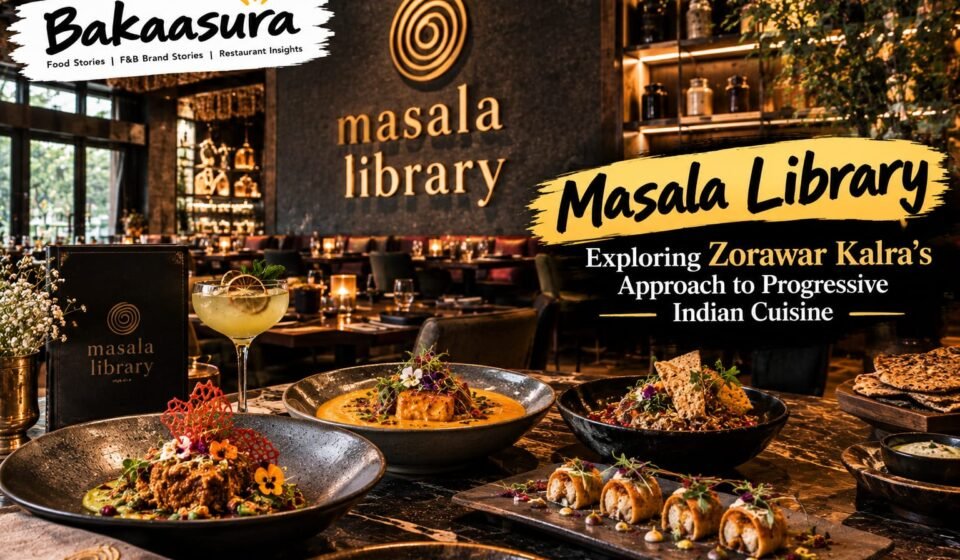

Indian cuisine is built on centuries of regional traditions, cooking techniques, ingredients and recipes. Masala Library by Jiggs Kalra was created around the idea of bringing that culinary heritage into a sophisticated contemporary dining experience.
The restaurant is closely associated with the father-son culinary legacy of Jiggs Kalra and Zorawar Kalra. The official Masala Library story describes the restaurant as a showcase of the diverse cuisines of the Indian subcontinent, combining traditional culinary heritage with modern cooking techniques.
For Zorawar Kalra, Masala Library became an important part of his restaurant journey and the portfolio of Massive Restaurants, the company he launched in 2012. The group identifies Masala Library as its signature premium fine-dining brand.
The restaurant’s identity is built around a simple but ambitious idea: take India’s traditional flavours and present them through a progressive gastronomic experience.
The Story Behind Masala Library
Masala Library emerged from the culinary vision shared by Jiggs Kalra and his son Zorawar Kalra.
Jiggs Kalra was widely known for his work as a food writer, gastronome, consultant and culinary ambassador for Indian cuisine. The official Masala Library website credits him with decades of work documenting, promoting and preserving India’s culinary traditions.
Zorawar Kalra subsequently developed his own restaurant business while drawing on his father’s knowledge and experience.
According to YourStory, Zorawar had considered the Masala Library concept several years before its eventual launch and saw an opportunity to combine Indian cuisine with modern culinary techniques.
The result was a restaurant concept that treated Indian food as a sophisticated gastronomic experience rather than simply traditional restaurant fare.
Zorawar Kalra and Massive Restaurants
In December 2012, Zorawar Kalra launched Massive Restaurants Pvt. Ltd., with Jiggs Kalra serving as a mentor to the venture.
The company was established with a broader ambition of creating restaurant brands across different market segments while showcasing the evolution of Indian cuisine. Its portfolio included Masala Library, Made in Punjab, Farzi Café and Pa Pa Ya, among other concepts.
Masala Library became the premium fine-dining expression of this philosophy.
While Made in Punjab focused on Punjabi cuisine and Farzi Café developed a modern Indian bistro format, Masala Library concentrated on a more elaborate and progressive interpretation of Indian culinary traditions.
Jiggs Kalra’s Culinary Legacy
The name of Jiggs Kalra is central to the identity of Masala Library.
The restaurant’s official history describes him as a pioneer of Indian gastronomy who spent decades documenting India’s culinary traditions and introducing Indian food to wider audiences.
His influence can be seen in Masala Library’s emphasis on regional recipes, traditional preparations and the history behind Indian dishes.
The restaurant is therefore not positioned simply as another fine-dining establishment. Its concept is also connected to the preservation and reinterpretation of Indian culinary heritage.
A New Approach to Indian Cuisine
One of Masala Library’s defining ideas is the combination of traditional Indian preparations with modern cooking techniques.
The official brand describes its culinary philosophy as combining centuries-old traditions with contemporary techniques while retaining the traditional character of the preparations.
This philosophy helped establish Masala Library within the progressive Indian cuisine movement.
Rather than abandoning traditional recipes in favour of completely new flavours, the restaurant uses established Indian culinary ideas as the foundation for experimentation.
Read this – SodaBottleOpenerWala – From Quirky Restaurant Concept to Recognised Food Brand
The Influence of Molecular Gastronomy
Masala Library became particularly associated with the use of modern and molecular-gastronomy-inspired techniques in Indian cuisine.
YourStory reported that the restaurant was among the early Indian concepts to incorporate molecular gastronomy into its culinary approach.
Contemporary coverage also highlighted dishes that transformed familiar Indian flavours through new textures, presentations and techniques.
This approach was part of Zorawar Kalra’s wider attempt to make Indian cuisine more relevant to younger and internationally exposed diners.
Traditional Flavours, Modern Presentation
The philosophy behind Masala Library is not simply about making food look different.
Zorawar Kalra has described his broader restaurant approach as elevating Indian food and presenting it in a modern form while retaining its traditional roots. Condé Nast Traveller, for example, highlighted dishes such as Dal Chawal Arancini and Rasmalai Tres Leches when discussing this approach.
The contrast between familiar flavours and unexpected formats became an important part of the restaurant’s identity.
Dishes could reference traditional Indian comfort food, regional preparations or classic desserts while using techniques and presentations associated with contemporary gastronomy.
Exploring India Through Food
Masala Library’s menu philosophy extends across India’s regional culinary landscape.
The official brand describes its offering as representing culinary traditions from across the geographical regions of India and the wider Indian subcontinent. It also places emphasis on forgotten recipes, regional traditions and the historical lineage of dishes.
This gives the restaurant a strong storytelling element.
Each dish can function not only as food but also as a representation of a particular region, tradition or cooking technique.
The Tasting Menu Experience
Masala Library also became associated with the tasting-menu format.
India Today reported in 2017 that the Delhi restaurant was offering a tasting menu and described it as the first restaurant in the city to offer such a format at the time.
A tasting menu allowed the restaurant to present Indian cuisine as a sequence of culinary experiences rather than as a conventional meal built around individual dishes.
This format also suited the restaurant’s progressive approach, allowing chefs to demonstrate different techniques, ingredients and regional influences within one dining experience.
Read this – Street Foods of India – The Journey Behind a Popular Indian Restaurant Brand
Masala Library as a Flagship Brand
Within Zorawar Kalra’s restaurant portfolio, Masala Library has held a particularly important position.
In an interview with Telegraph India, Kalra described Masala Library as the group’s flagship restaurant and noted that it was the only restaurant in the portfolio carrying his father’s name on the door.
That connection gives the brand a distinct place within the Massive Restaurants story.
It represents both the continuation of Jiggs Kalra’s culinary legacy and Zorawar Kalra’s effort to develop a modern restaurant business around Indian cuisine.
Building a Modern Identity for Indian Food
Masala Library was part of a wider shift in India’s restaurant industry toward contemporary interpretations of traditional cuisine.
Zorawar Kalra’s stated objective was to make Indian cuisine more appealing to younger and globally exposed diners. Business Standard reported that his restaurant concepts were designed to bring progressive Indian food closer to this emerging audience.
Masala Library approached that objective through fine dining, sophisticated presentation and modern culinary techniques.
The result was a restaurant concept that placed Indian cuisine at the centre of a contemporary gastronomic experience.
The Legacy of Masala Library
Masala Library’s importance within the Kalra family’s restaurant journey extends beyond individual dishes.
The restaurant became a platform for exploring India’s culinary diversity while experimenting with the way that food could be cooked, presented and experienced.
Its philosophy also reflects a broader principle associated with Jiggs and Zorawar Kalra: Indian cuisine can evolve without losing its connection to its roots.
Read this – Made in Punjab Restaurant Story – How Zorawar Kalra Built a Punjabi Food Brand
Key Points
- Masala Library by Jiggs Kalra is a progressive Indian fine-dining restaurant concept.
- The brand is closely connected to Jiggs Kalra and Zorawar Kalra.
- Zorawar Kalra developed the concept as part of his wider restaurant business journey.
- Masala Library became a signature premium fine-dining brand under Massive Restaurants.
- The restaurant combines traditional Indian culinary heritage with modern cooking techniques.
- Its philosophy highlights regional cuisines, traditional recipes and forgotten flavours.
- Molecular-gastronomy-inspired techniques became an important part of its early identity.
- The restaurant has used tasting-menu formats to present Indian cuisine as a progressive gastronomic experience.
- The brand carries forward the culinary legacy of Jiggs Kalra while reflecting Zorawar Kalra’s modern restaurant vision.
Conclusion
Masala Library by Jiggs Kalra represents an important chapter in the story of contemporary Indian dining. Built around the culinary legacy of Jiggs Kalra and developed through Zorawar Kalra’s restaurant journey, the concept brought together traditional Indian cuisine, regional culinary history and modern gastronomic techniques.
Its identity goes beyond fine dining. Masala Library uses food as a way to explore India’s culinary heritage while presenting familiar traditions in contemporary forms.
For Zorawar Kalra, the restaurant became a flagship expression of the philosophy behind Massive Restaurants: showcasing the depth of Indian cuisine while creating restaurant experiences designed for modern diners.