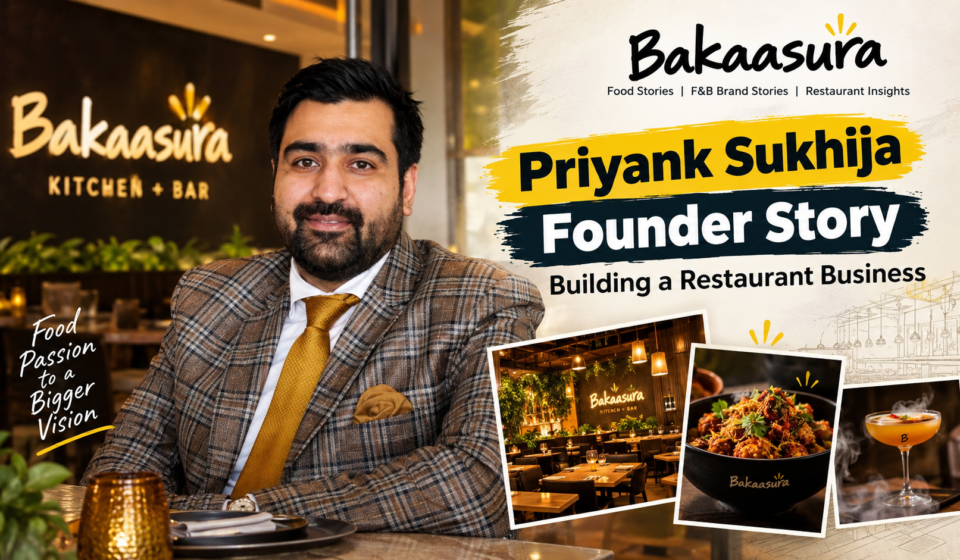

Priyank Sukhija is one of the better-known names in India’s modern restaurant and nightlife industry. His entrepreneurial journey began unusually early. At just 19, after leaving college, he entered the restaurant business and opened Lazeez Affaire in New Delhi in 1999. What began as a single restaurant eventually developed into First Fiddle Restaurants, a multi-brand hospitality company known for restaurants, bars, cafés and experiential dining concepts.
Unlike traditional restaurant businesses that often focus primarily on cuisine, Sukhija built many of his ventures around a larger idea: the concept itself should become part of the dining experience.
That philosophy can be seen across brands associated with First Fiddle, including Lazeez Affaire, Lord of the Drinks, The Flying Saucer Café, Tamasha, Plum by Bent Chair, Diablo, Dragonfly, MisoSexy, Warehouse Café and other concepts. Over the years, his company expanded beyond Delhi into markets including Mumbai, Pune, Lucknow and other Indian cities.
His journey, however, has not been a simple story of uninterrupted success. He has spoken openly about ambitious expansion plans that did not always materialise, difficult restaurant economics, regulatory challenges and the risks involved in operating large-format hospitality businesses.
Today, his career represents the evolution of India’s organised restaurant industry from conventional dining toward experience-driven brands.
From a Family of Lawyers to a Restaurant Entrepreneur
Priyank Sukhija came from a family of lawyers rather than entrepreneurs. He has described himself as the first person in his family to enter business.
While studying, Sukhija developed a strong interest in food, hospitality and entertainment. His lack of enthusiasm for conventional academics eventually led him to leave college and pursue entrepreneurship.
Reports about his early years also mention dyslexia as one of the challenges he faced during his education. Instead of following a conventional professional path, he chose to build a career around his interest in food, design and hospitality.
The Bowling Alley That Did Not Work
Before opening his first successful restaurant, Sukhija experimented with another business idea.
Business Standard reported that, at 19, he invested in a bowling-alley project that failed to take off. Local restrictions reportedly prevented the project from developing as planned.
The failed venture became an early lesson in entrepreneurship.
Rather than abandoning business altogether, Sukhija moved toward the sector he was more passionate about: restaurants.
1999: The Beginning of Lazeez Affaire
In 1999, Sukhija received financial support from his parents and opened Lazeez Affaire in New Delhi.
The restaurant was established on Malcha Marg and focused on North Indian cuisine and fine dining.
At the time, India’s organised restaurant sector was considerably smaller than it is today. Sukhija entered the market when restaurant concepts were still largely associated with either traditional dining or premium hotel restaurants.
Lazeez Affaire became the foundation for what would eventually become First Fiddle Restaurants.
The company’s official history identifies 1999 as the beginning of its journey and describes Lazeez Affaire as its first brand.
Turning One Restaurant Into a Business Model
The success of Lazeez Affaire gave Sukhija confidence to experiment with different restaurant formats.
Instead of simply opening more outlets of the same restaurant, he began developing new brands.
This became one of the most distinctive characteristics of his business strategy.
Each restaurant could have its own:
- Name
- Cuisine
- Interior design
- Music
- Target customer
- Price positioning
- Service style
- Entertainment proposition
The idea was to create destinations rather than simply restaurants.

The Birth of First Fiddle Restaurants
First Fiddle Restaurants, formerly associated with the Lazeez Affaire Group, grew from the original 1999 venture into a multi-brand hospitality company.
The company’s official website describes First Fiddle as a pioneer in casual and experiential dining and says it has developed more than 15 brands and more than 35 outlets.
Its portfolio has changed over the years as some concepts expanded, evolved or were replaced by new ideas.
Among the brands associated with Sukhija and First Fiddle have been:
- Lazeez Affaire
- Lord of the Drinks
- The Flying Saucer Café
- Tamasha
- Warehouse Café
- Plum by Bent Chair
- Dragonfly
- Diablo
- MisoSexy
- Daddy
- Teddy Boy
- Wolf
- Bougie
- Other restaurant and nightlife concepts
The portfolio demonstrates Sukhija’s willingness to experiment with different formats rather than depending on one restaurant identity.
Read this – India’s top restaurant founders and restaurateurs
Building Restaurants Around Concepts
The central idea behind Sukhija’s business was that customers should remember more than the food.
They should remember the atmosphere.
This approach became particularly visible in concepts such as Lord of the Drinks, The Flying Saucer Café, Tamasha and Plum by Bent Chair.
The restaurants were designed around strong visual identities, interiors, music, menus and social experiences.
Business Today reported in 2019 that Sukhija was involved in the entire process of setting up restaurants, including concept development, hiring chefs and restaurant staff, and marketing.
That level of involvement helped him maintain control over how a restaurant concept was presented to customers.
Lord of the Drinks: Creating a Scalable Nightlife Brand
Lord of the Drinks became one of the most recognisable brands associated with First Fiddle.
The concept combined food, beverages, entertainment and a distinctive interior environment.
By 2019, Business Today reported that Lord of the Drinks had expanded to 13 outlets across Delhi-NCR, Pune and Mumbai, with further expansion planned.
The brand demonstrated an important shift in Sukhija’s strategy.
Instead of treating nightlife as a single-location business, he attempted to turn it into a repeatable restaurant and bar format.
That helped create a recognizable brand identity that could be introduced in different cities.
Out of the Box and the Evolution of Casual Dining
Out of the Box was another important concept associated with Sukhija’s early expansion.
The restaurant represented a move toward casual dining at a time when the Indian market was increasingly becoming receptive to restaurants that offered food, drinks, music and social interaction in one location.
Sukhija has spoken about creating a middle ground between conventional fine dining and clubbing.
That philosophy became central to his expansion strategy and helped shape the type of experiential restaurants that later became common in India’s major cities.
Tamasha, Plum and the New Generation of Concepts
As the business matured, Sukhija moved toward increasingly specialised concepts.
Tamasha developed as a large-format dining and nightlife destination.
Plum by Bent Chair introduced another dimension to the restaurant experience by combining food with an interior environment where furniture and design elements became part of the proposition.
Business Standard reported that Plum by Bent Chair opened in Delhi’s Aerocity in 2018 and that Sukhija said the investment had reached break-even within a year.
The concept demonstrated how restaurant interiors could become commercially meaningful rather than merely decorative.
Expansion Beyond Delhi
Delhi remained the heart of Sukhija’s restaurant business, but the company eventually expanded into other Indian markets.
First Fiddle’s expansion included cities such as Mumbai and Pune, while later plans and operations extended into markets including Lucknow and other cities.
The strategy involved selecting locations carefully.
Sukhija has been particularly vocal about the importance of real estate and location in restaurant success.
A Business Today profile noted his familiarity with major high streets and malls and highlighted his strategy of opening restaurants in prominent areas such as Connaught Place.
For a restaurant business, location can influence visibility, footfall, rental costs and the type of customer a brand attracts.
Sukhija treated location selection as part of the concept rather than simply a property decision.
Read this – Who Is Amit Burman? Founder Story, Career and Business Journey
The Business Growth Story
By 2019, Business Today reported that First Fiddle was operating approximately 15 brands and 30 properties, with revenue exceeding ₹200 crore in the financial year discussed in the interview.
Sukhija’s focus was also changing.
Earlier, the company had concentrated on creating new brands.
Later, he said he wanted to build existing brands into larger chains instead of continuously launching new concepts.
This represented an important evolution from experimentation to scalability.
The company was no longer simply testing restaurant ideas; it was attempting to determine which concepts could be replicated across cities.
Challenges and Business Setbacks
The restaurant industry is highly competitive, and Sukhija’s career includes several examples of the risks involved.
His early bowling-alley project did not succeed.
Later, he acknowledged that some of his business projections were overly optimistic.
In a 2019 Business Today interview, Sukhija openly admitted that he had sometimes been too ambitious about growth and revenue projections. He explained that strategic decisions, including changes in plans around external capital, had affected earlier projections.
This is an important part of understanding his entrepreneurial journey.
Rapid expansion can create opportunities, but restaurants also carry substantial fixed costs involving rent, salaries, fit-outs, food operations, licensing and marketing.
Regulatory and Industry Pressure
Sukhija has also been outspoken about regulatory challenges facing India’s restaurant industry.
In 2019, he argued that restaurants were dealing with issues including licensing requirements, operating-hour restrictions and the absence of input tax credit under the GST framework applicable to restaurants at the time.
He said these factors increased the cost of operating organised restaurants.
These challenges were not unique to First Fiddle.
They reflected wider structural issues facing India’s hospitality sector.
Restaurant Fires and Operational Risks
Sukhija’s journey has also involved serious operational incidents.
The Economic Times reported that one of his restaurants in Hauz Khas, Delhi, was destroyed by fire in 2011.
According to the report, the restaurant was empty when the first fire occurred and was reopened within two months after rebuilding. The same report also discussed another fire incident involving one of his restaurants that resulted in the deaths of two security guards.
These incidents highlight an often-overlooked reality of restaurant entrepreneurship.
Behind the glamorous interiors, food and nightlife is an industry that requires strict attention to fire safety, staffing, licensing, building compliance and operational risk.
Was There a Downfall?
There is no reliable basis in the sources reviewed to describe Priyank Sukhija or First Fiddle as having experienced a complete business downfall.
There have certainly been setbacks.
These include failed early ventures, ambitious expansion targets that were not always achieved, difficult restaurant economics, regulatory pressures and operational incidents.
However, these events are better described as business challenges and setbacks rather than evidence of a complete collapse.
The company has continued to introduce concepts and operate restaurants, while Sukhija remains associated with First Fiddle’s leadership. First Fiddle’s current corporate website continues to describe the business as a major Indian F&B company with a multi-brand portfolio.
Read this – What Are the Best Restaurants on Church Street, Bangalore?
Awards and Recognition
Priyank Sukhija’s career has received recognition from several restaurant and hospitality organisations.
One documented milestone came at the Indian Restaurant Congress Awards 2014, where he was named Restaurateur of the Year.
He received the same broad recognition again in the Indian Restaurant Awards 2016, where he was listed as Restaurateur of the Year for the Lazeez Affaire Group.
In 2016, the Times Food Guide Awards also recognised Sukhija as Restaurateur of the Year.
In 2017, Restaurant India reported that Sukhija received the Restaurant Icon of the Year recognition at the Indian Restaurant Congress.
In 2018, he was recognised as Night Life Creator of the Year at the Indian Restaurant Awards.
In 2022, the ET HospitalityWorld Restaurant and Nightlife Awards named him Restaurateur of the Year – North.
More recently, the Times Food & Nightlife Awards 2025 listed Priyank Sukhija as Nightlife Entrepreneur of the Year.
These recognitions reflect his long-standing presence in India’s restaurant and nightlife sector.
The Role of Design and Interiors
One of Sukhija’s distinguishing characteristics has been his emphasis on design.
Restaurant India describes his fascination with design and interiors as a major part of his approach to restaurant creation.
This philosophy can be seen across several First Fiddle concepts.
The objective was not necessarily to make every restaurant look the same.
Instead, the design was intended to support the identity of each brand.
A medieval-inspired bar, an Asian restaurant, a North Indian fine-dining venue and a large-format nightlife destination could therefore have completely different visual languages.
Learning From Travel and Global Trends
Travel has also influenced Sukhija’s approach to hospitality.
He has spoken about how changing food and lifestyle trends influence restaurant concepts.
The idea is to observe international dining trends and then adapt them for Indian consumers rather than simply copying overseas restaurants.
That approach is visible in the company’s experimentation with cuisines including Chinese, Japanese, Peruvian and Thai food.
The Shift From More Brands to Stronger Brands
One of the most important strategic lessons from Sukhija’s career came when he acknowledged the need to move away from launching endless new concepts.
In his 2019 Business Today interview, he explained that the company had earlier focused heavily on creating new brands but was shifting toward building selected brands into chains.
This is a critical distinction in restaurant entrepreneurship.
Creating a successful single outlet is one challenge.
Building a brand that can operate consistently across ten, twenty or thirty locations is a completely different challenge.
Standardised food quality, staff training, procurement, marketing, real estate and customer experience all become essential.
Priyank Sukhija’s Leadership Philosophy
Sukhija’s career suggests several principles that have influenced his restaurant strategy.
1. Build a Concept, Not Just a Restaurant
The name, interiors, music, food and service should work together.
2. Understand the Location
A strong concept can struggle in the wrong location, while a carefully selected property can strengthen a brand.
3. Experiment With Consumer Trends
Restaurant preferences change quickly, making experimentation important.
4. Create Different Brands for Different Audiences
A single restaurant format cannot necessarily serve every customer segment.
5. Learn From Failure
The bowling-alley setback and missed business projections became part of his entrepreneurial learning curve.
Major Milestones in Priyank Sukhija’s Career
- Born into a family of lawyers.
- Developed an early interest in food and hospitality.
- Left college at 19 to pursue entrepreneurship.
- Experimented with a bowling-alley business that did not succeed.
- Opened Lazeez Affaire in New Delhi in 1999.
- Built the Lazeez Affaire Group into a broader hospitality business.
- Developed the First Fiddle Restaurants identity.
- Expanded into casual dining and nightlife concepts.
- Built brands including Lord of the Drinks, Tamasha and The Flying Saucer Café.
- Developed newer concepts such as Plum by Bent Chair, Dragonfly, Diablo and MisoSexy.
- Expanded the restaurant portfolio beyond Delhi.
- Became associated with more than 30 restaurant outlets during the company’s major expansion phase.
- Received multiple Restaurateur of the Year recognitions.
- Was recognised as Restaurant Icon of the Year in 2017.
- Received Night Life Creator of the Year recognition in 2018.
- Was named Restaurateur of the Year – North by ET HospitalityWorld in 2022.
- Received Nightlife Entrepreneur of the Year recognition at the Times Food & Nightlife Awards 2025.
Read this – Family Restaurants in Banashankari
Achievements at a Glance
Priyank Sukhija’s biggest achievement has been the transformation of one restaurant into a multi-brand hospitality business.
He helped popularise the idea that restaurant brands could be built around experiences rather than cuisine alone.
His portfolio has covered fine dining, casual dining, bars, cafés, nightlife and experiential formats.
Another significant achievement has been the longevity of Lazeez Affaire. The restaurant that began his journey in 1999 has remained part of the First Fiddle story decades later.
His awards across multiple years also demonstrate his sustained visibility within India’s restaurant industry.
The Business Lessons From Priyank Sukhija’s Journey
Sukhija’s story offers several lessons for aspiring restaurant entrepreneurs.
The first is that a restaurant needs an identity.
The second is that one successful concept can become the foundation for multiple businesses.
The third is that growth requires more than creativity. Operations, location, finance, licensing, staffing and safety are equally important.
The fourth is that failure is part of entrepreneurship.
His unsuccessful bowling-alley venture and missed projections show that even experienced entrepreneurs can miscalculate markets and growth.
Finally, his career demonstrates that restaurants can function as brands.
When food, design, entertainment and storytelling work together, customers may remember the entire experience rather than only the meal.
Conclusion
Priyank Sukhija’s journey from a 19-year-old college dropout to the founder and leader of First Fiddle Restaurants is one of experimentation, risk-taking and concept-driven hospitality.
His first restaurant, Lazeez Affaire, established the foundation. From there, he moved into casual dining, nightlife, cafés and experiential restaurants, developing brands such as Lord of the Drinks, Tamasha, The Flying Saucer Café, Plum by Bent Chair, Diablo and others.
The journey has also included failures and difficult periods. His early bowling-alley venture failed, some expansion projections were not achieved, and the restaurant industry presented regulatory, financial and operational challenges. Fires at restaurants also demonstrated the serious risks involved in hospitality operations.
Yet the broader trajectory has been one of continued experimentation and expansion.
The most distinctive part of Sukhija’s approach has been his focus on concepts. He treated a restaurant as more than a kitchen and dining room; the name, location, interiors, music, food and customer experience were all components of the brand.
From Lazeez Affaire in 1999 to a multi-brand First Fiddle portfolio, his career illustrates how creativity can become a business strategy in India’s competitive hospitality industry.